
DEEP: The Post-Platform OS for Intelligent Experience Ecosystems
The digital experience industry is at a crossroads. We’ve spent the past decade evolving from simple CMS websites to full-fledged Digital Experience Platforms (DXPs) that promised to manage every touchpoint. Yet, as we stand in 2025, it’s clear that the next leap forward won’t come from yet another all-in-one platform. It will come from a new philosophy altogether. I call this new paradigm DEEP, or Digital Experience Enablement Platform. At its core, DEEP is about moving from delivering static, vendor-defined platforms to enabling dynamic, intelligent ecosystems. Instead of one vendor dictating how experiences are built, DEEP offers an open operating system for digital experience, one that empowers organizations to compose, innovate, and intelligently automate across a whole ecosystem of tools and channels. If DXP defined the platform era of digital experience, DEEP marks the post-platform era, where the focus shifts from control to enablement. The goal is to give organizations the freedom to create evolving, intelligent, and tailored digital experiences.
Why We Need a New Category
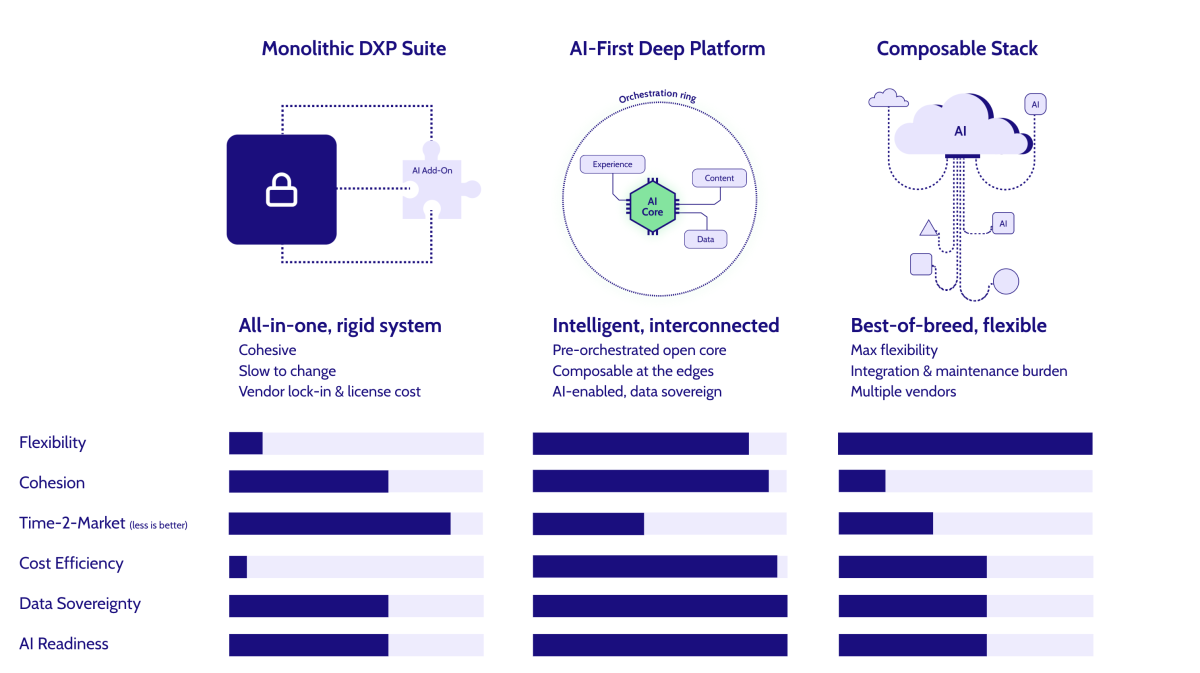
The world has changed, and so must our approach to digital experience. Traditional DXPs, often tied to large vendors, were built for a time when enterprises wanted one suite to manage web, mobile, content, and marketing. They solved some problems but created new ones: vendor lock-in, limited agility, high costs, and slow innovation. The “composable” movement emerged in response, letting organizations mix and match best-of-breed tools. But while this brought agility, it also introduced complexity in integration and maintenance. Now, add two powerful modern forces to the mix: the rise of AI and the demand for digital sovereignty. AI is transforming personalization and automation, yet most legacy platforms can’t integrate it meaningfully. Meanwhile, sovereignty, control over data and infrastructure, is becoming essential, especially in Europe, where data privacy and independence are non-negotiable. These pressures demand something new. We need a framework that combines flexibility with simplicity, intelligence with control. DEEP is that answer, a new strategic category designed to be open, composable, intelligent, and sovereign by design.
The Digital Experience Operating System
Think of DEEP as your organization’s digital experience operating system. Just as an OS coordinates hardware and software, a DEEP coordinates content, data, and channels, ensuring they work together seamlessly. A true DEEP isn’t owned by a single vendor. It’s an open framework built from interoperable components, often open-source, with an intelligent orchestration layer on top. At Dropsolid, for example, our DEEP combines Drupal (content OS), Mautic (marketing OS), and Apache Unomi (customer data OS), layered with AI-driven orchestration and a unified dashboard. The result is a system that enables digital experiences rather than imposing a fixed one. Organizations can plug in or swap components as needed, maintaining flexibility without losing cohesion. This balance, the agility of composable stacks with the cohesion of integrated solutions, is the hallmark of DEEP.
The Defining Traits of a DEEP
To understand what makes DEEP different, let’s explore its four defining characteristics.
1. Open and Composable at the Core
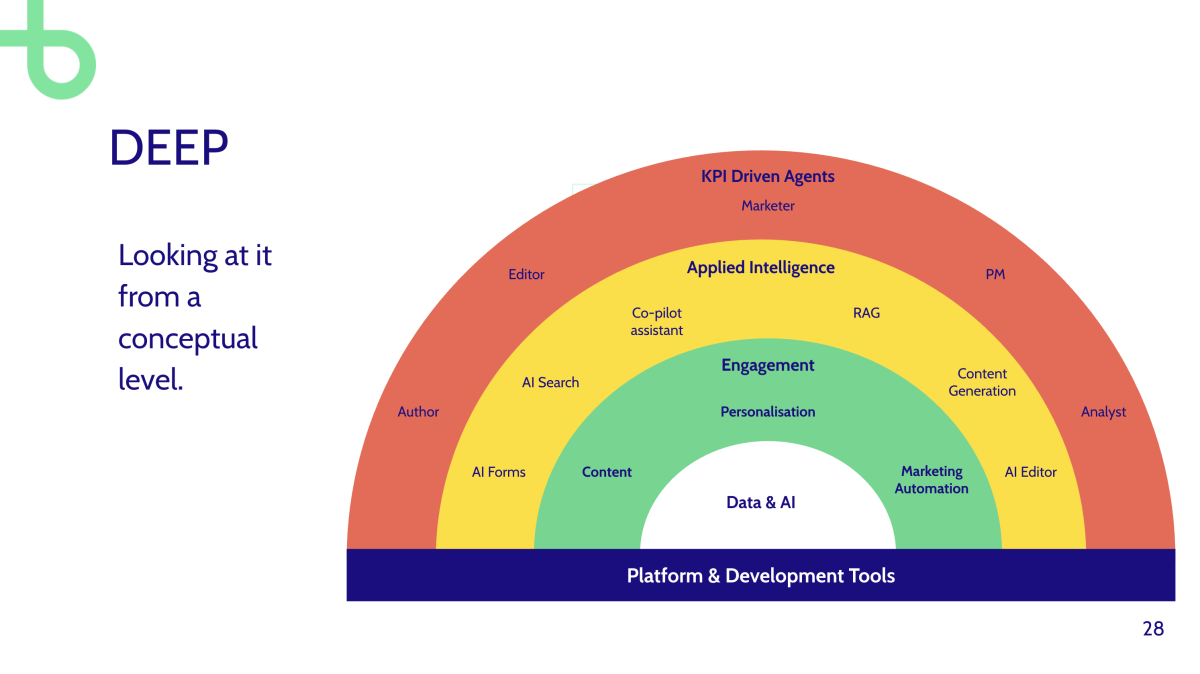
At its foundation, DEEP is open and composable. This openness is non-negotiable because it grants organizations true digital independence. With open-source components, you’re never tied to a vendor’s roadmap or licensing decisions, you can evolve your platform on your own terms. Composability allows you to select the best tool for each function and still ensure they work together harmoniously. A DEEP provides a recommended baseline, content, personalization, marketing, but if a better solution emerges, you can integrate it without waiting for a monolithic vendor to catch up. It’s like building with Lego blocks with modular, interoperable pieces that evolve continuously. This approach keeps innovation alive and ensures your digital ecosystem never stagnates.
2. Orchestrated and Intelligent
Having multiple tools isn’t enough. The true value of DEEP lies in how intelligently everything works together. DEEP includes an enablement layer that manages integration, data flow, and automation. Your customer data platform informs your CMS, which in turn adjusts content delivery and marketing actions in real time. Here, AI becomes the conductor of the ecosystem by detecting patterns, optimizing workflows, and personalizing experiences automatically. DEEP transforms into a digital experience autopilot that teams can guide strategically rather than manage manually. This AI-driven orchestration enables personalization at scale, automated tagging and routing, smart assistants, and adaptive marketing triggers. AI is the brain of the system, woven throughout the experience fabric. In practical terms: the system grows smarter, the workload lightens, and your team can focus on creativity and strategy.
3. Sovereign and Secure by Design
A DEEP is built to preserve digital sovereignty, your right to control your data, infrastructure, and destiny. Traditional DXPs often lock companies into proprietary systems or cloud dependencies. DEEP reverses that. Because it’s open, you can host it wherever it makes sense, including on your own cloud, on-premise, or through a trusted regional provider. This flexibility ensures compliance with local regulations, strengthens security, and reduces vendor risk. Open-source communities continually harden these systems, while you maintain full visibility and control. Sovereignty and security go hand in hand: you know where your data lives, who accesses it, and how it’s protected. For European organizations especially, this isn’t just a benefit. It’s a necessity.
4. Community and Ecosystem-Driven
Perhaps DEEP’s greatest strength lies in its community-driven innovation. Modern digital experience breakthroughs are happening in open communities like Drupal, Mautic, Apache Unomi, and beyond. DEEP connects to all of this collective intelligence, benefiting from an entire ecosystem’s R&D instead of one company’s. We’ve seen this firsthand through initiatives like Drupal Canvas (formerly known as Experience Builder) and Drupal AI, where competitors collaborate on shared progress. This open collaboration model fuels faster, more sustainable innovation. In many ways, DEEP could become to digital experience what Linux became to operating systems, a foundational, community-driven layer that powers limitless innovation.
From Vision to Reality
Some might call this vision idealistic. But it’s already happening. At Dropsolid, we’ve proven that open DXP implementations can meet enterprise needs, delivering personalization, content management, and marketing automation without vendor lock-in. Clients across Europe use DEEP-style architectures for exactly this reason: they gain control and flexibility while innovating freely. Some have extended our platform with custom e-commerce modules or integrated AI models for predictive content. These are projects that would have been impossible under closed DXPs. Even large enterprises, like telecom providers, are now exploring DEEP proof-of-concepts because they want enablement, not dependency.
Looking Ahead
I believe that within a few years, Digital Experience Enablement Platforms will be as widely recognized as DXPs once were. Analysts will talk about “Experience Enablement” or “Open DXP” as the logical evolution. This shift redefines success, not by how many features a vendor packs into a suite, but by how well a platform empowers teams to build their own experiences. It’s a move from product-centric to people-centric digital thinking.
Conclusion: The Dawn of the Enablement Era
Having lived through the rise of CMS, the evolution of DXP, and now the infusion of AI, I’m convinced DEEP is the future of our industry. It’s a culmination of what came before. It combines the composability of modern architecture, the lessons of DXP, and the intelligence of AI to create something more open, flexible, and empowering. Organizations that embrace this model will gain the freedom to innovate continuously, confident their digital foundations will adapt to whatever the future brings, new channels, customer needs, or regulations. To every digital leader reading this: imagine a world where your imagination, not your license agreement, defines what’s possible. That’s the world DEEP enables. a world where technology serves creativity, and platforms empower people. This is the dawn of the enablement era. With AI as its engine and openness as its foundation, DEEP will redefine what digital experience means for the decade ahead. Let’s build that future together.
Add new comment